The Network of Tax Organisations members participate in the 2022 CIAT Technical Conference

10/13/2022 Members of the Network of Tax Organisations (NTO) participated in the Centro Interamericano de Administraciones Tributarias (CIAT) Technical Conference which was held between 4 and 6 October 2022 at Granada, Spain. The conference theme was “The Sapiens administration: Information and knowledge management to improve the prevention and struggle against fraud”. In further exploration of the theme – cross-border cooperation between different tax administration jurisdictions, CIAT organised a roundtable with NTO Members titled “Perspectives and challenges of tax organisations: The digital divide” which saw the active engagement of NTO members.  In addition to CIAT, the NTO members that participated in the roundtable were African Tax Administration Forum (ATAF), Association of Tax Authorities of Islamic Countries (ATAIC), Commonwealth Association of Tax Administrators (CATA), Caribbean Organization of Tax Administrators (COTA), Cercle de Réflexion et d’Échange des Dirigeants des Administrations fiscales (CREDAF), Intra-European Organisation of Tax Administrations (IOTA), and West African Tax Administration Forum (WATAF). For additional details, please click here

The Network of Tax Organisations members participate in the 2022 CIAT Technical Conference Read More »

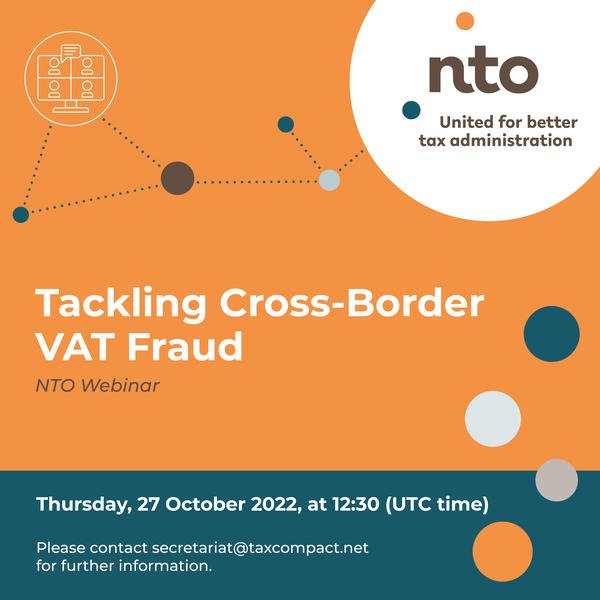
NTO Webinar on Tackling Cross-Border VAT Fraud

10/14/2022 Value Added Tax (VAT) is a form of indirect tax levied on goods and services by more than 170 countries. Often, VAT constitutes an important pillar of government revenue. However, the interconnectedness of national economies has contributed to increasing avenues for avoiding and evading VAT obligations. There are several varieties of VAT fraud. However, these frauds are groupable into two broad categories. The first category is the classic underreporting of VAT obligations to the government. The second variety of VAT-based fraud often involves organised complex chains of interconnected transactions and economic agents across national boundaries. These economic agents exploit the weakness of VAT systems across trade jurisdictions with the primary aim of defrauding governments of tax revenue. For instance, missing trader intra-community fraud-a variety of cross-border VAT fraud accounts for about EUR 60 billion yearly loss in revenue to European Union (EU) member states. On 27 October 2022, the Network of Tax Organisations will hold a webinar on “Tackling Cross-Border VAT Fraud”. Through real-world case presentations, representatives from the General Directorate of Public Finance (DGFIP) of France and the South African Revenue Services will provide insights into the patterns of cross-border fraud and mechanisms for tackling its. In addition, the African Tax Administration Forum (ATAF) will provide further highlights on cross-border VAT fraud from the perspective of a regional tax organisation. Please find the concept note and programme of the event. Here is the French and Spanish version of the concept note. For more information, please get in touch with secretariat @taxcompact.net

NTO Webinar on Tackling Cross-Border VAT Fraud Read More »

ATI and ATAF host a side-event on tax and gender

10/28/2022 Gender equality forms a key part of the Sustainable Development Goals (SDGs) and the global effort on the reduction of poverty and the realisation of economic development for all. The COVID-19 pandemic has deepened inequality and widened economic gaps between women and men by reversing previously recorded gains, there by threatening the attainment of this goal. Public finance, particularly taxation, as a well recognised source of sustainable finance, plays a crucial role in the elimination of gender and other forms of inequality in developing countries and elsewhere. For instance, taxes can be designed to encourage greater women participation in the labour force, by among others, providing child tax credits, etc. This helps to boost economic growth for better development and social outcomes. Tax policy can also be reformed in ways that tackle the existing biases of tax systems. The Addis Tax Initiative (ATI) recognises the profound impact of tax and domestic revenue mobilisation policies in reducing gender inequality. One of the principles that form the foundation of the ATI cooperation is that members’ will “strive to promote gender-responsive action as part of all ATI partnerships and initiatives, including by collecting and evaluating appropriate data within the ATI”. In practice of this principle, the Addis Tax Initiative (ATI), in collaboration with the African Tax Administration Forum (ATAF), is organising a side-event titled “A gendered approach to taxation: Improving the equitability and efficiency of DRM” on 31 October 2022 at the 7th ATAF General Assembly in Lagos, Nigeria. Among the expected participants are the representatives of tax administrations, Ministry of Finances (MoF) of ATAF member countries, ATI partner countries, development partners, and supporting organisations. The gender impact of tax policy is also recognised by ATAF as one of the challenges that confronts African governments’ DRM efforts. In 2021, ATAF launched its Women in Tax Network (AWITN), seeking to bring more women into higher positions in tax matters and raise awareness on the interconnectivity between tax policy and gender equality. The ATAF-ATI side event will feature sessions to highlight the various aspects of the emerging tax and gender dialogue. It will shade light on the nature of gender biases in tax systems, on how these biases affect women’s participation in the labour force, and on the role of gender disaggregated data in policymaking. Generally speaking, tax biases can be implicit or explicit. While explicit biases are easily delectable from the tax codes of countries, the opposite holds true for the former. Implicit biases refer to the gendered difference in the outcome of tax policy or tax administration which arises due to the gendered patterns of social arrangement, gender pay gaps, and economic behaviour. The biases differ from country to country due to differences in design and local contexts, such as the level of development, the nature of the economy, the gender gaps in education, and the level of economic empowerment. Tax policymakers and practitioners from Ghana, Nigeria, and Seychelles together with a representative from United Nations Department of Economic and Social affairs (UNDESA) will join the panel session to share their perspectives. The session on gender disaggregated data will focus on how data positively contributes to better tax policy reforms demonstrated by the works of ATAF, the International Monetary Fund (IMF), and the Organisation for Economic Cooperation and Development (OECD). For more details of the side-event and to register for a virtual participation, follow the link here.

ATI and ATAF host a side-event on tax and gender Read More »

Tackling Cross-Border VAT Fraud

11/08/2022 NTO Webinar One of the primary disadvantages of the increasing interconnectedness of national economies is the growing opportunities to abuse cross-jurisdiction tax rules. Cross-border VAT fraud, in particular, is a source of growing concern for tax administrators and organisations around the world. On 27 October 2022, the Network of Tax Organisations (NTO) hosted a webinar on “Tackling Cross-Border VAT Fraud”. Representatives from the General Directorate of Public Finance of France (DGFIP) and the South African Revenue Services (SARS) shared insights into tackling and preventing cross-Border VAT fraud through real-world examples. In addition, a representative from the African Tax Administration Forum (ATAF) provided further perspective on cross-border VAT fraud and how tax administrations can mitigate it. Over 200 participants attended the webinar. Mr. Massimo Morarelli, an International Expert from the Italian Revenue Agency and the Intra-European Organisation of Tax Administrations (IOTA), moderated the webinar. Mr. Morarelli highlighted the growing concern of cross-border VAT fraud by stating its adverse effect on domestic revenue mobilisation (DRM) and cross-border commerce. The two polls conducted in the webinar underscored the importance of cross-border VAT fraud in the respective tax administrations of the participants. The first poll asked the participants to indicate the most common variant of cross-border VAT fraud in their jurisdictions. The participants signified that Misuse of Customs Procedures, Carousel Fraud, and E-Commerce Fraud are the most common variants of cross-border VAT fraud they experience. In the second poll, the participants deemed that Increase of Advance International Cooperation Instruments is the best strategy to detect and tackle the issue. The first speakers, Ms. Marie-José Ferreiro and Mr. Axel Gonzalez, from the DGFIP, presented the EUROFISC network’s mandate and its current undertaking regarding tackling cross-border VAT fraud within the European Union (EU). The EUROFISC network, per Ms. Marie-José Ferreiro, derives its mandate from the European Council Regulation Number 904/2010. The primary objective of the network centres on fostering cooperation among tax administration of EU member states and combatting VAT fraud. There are several avenues for collaboration within the EUROFISC network. Follow-up collaborative work that permits the direct exchange of information between tax administrations is one of the most significant forms of cooperation within the network. Mr. Gonzalez highlighted two examples of such actions involving several member states for the purpose of early detection – the Missing Trader Intra Community (MTIC) Fraud and VAT Margin Fraud. Although the follow-up actions demanded the exchange of documents and information to provide evidence against fraud, they have yielded substantial results. For example, since 2020, these actions resulted in 61 early VAT Registration Number (VRN) deregistration, 50 inquiries and audits, and the reporting of over 100 suspected fraudulent activities of French traders by the Dutch Tax Administration. The second speakers, Mr. Hansie Griffin and Ms. Kebtetswe Thothela, from SARS, presented how their agency is combatting cross-border VAT fraud. Mr. Griffin commenced the presentation by highlighting the context of VAT fraud in South Africa. He mentioned that SARS has had to deal with VAT fraud since the institutionalisation of the VAT system in 1991. Ms. Thothela emphasised that VAT Carousel is the most common form of VAT fraud in the country by explaining the modus operandi of these schemes. She presented an example involving 11 vendors, with one vendor acting as the financier of the other. These vendors falsified various documents to claim VAT refunds. Unfortunately, the late detection of the scheme meant that a large portion of the false claims had been paid out. All in all, she signified that it is paramount for tax administrations to be vigilant of these schemes. Further, Mr. Griffin expanded on the South African experience by explaining how economic vendors in South Africa misrepresent the value of imported, high-value commodities to generate fictitious VAT claims. He noted that the biggest “pull” of these schemes has been the VAT refunds and how quickly these funds could be moved out of the tax jurisdiction of South Africa. Mr. Emeka Nwankwo provided insights on cross-border VAT fraud from a regional tax organisation’s perspective. Mr. Nwankwo noted that the issue of cross-border VAT fraud is pertinent for Africa, given the increasing contribution of VAT to government revenue across the continent. Mr. Emeka stated that tax administrators should be wary of VAT fraud perpetuated via services. He encouraged tax administrators to be proactive and thoroughly apply the “know your customer” principle to mitigate the challenges in their jurisdiction. He advised that when such schemes are uncovered, it is important that the cases are prosecuted and made public to serve as examples. Mr. Nwankwo noted that taxpayer education, encouragement of voluntary compliance, clear guidance on due diligence, automation (for example, Invoice Matching in Kenya), and collaboration of responsible (domestic and external) agencies are some of the avenues that could be employed by tax administrations. The presentations reiterated the complexities of cross-border VAT fraud across the world. They showed the need for collaboration if cross-border VAT fraud is to be mitigated. Tax administrators must be proactive and conversant with taxpayers and must seek collaboration with responsible (internal and external) agencies. The NTO appreciates the contribution of all the speakers and participants and will look forward to welcoming all to further webinars. As a peer-learning platform that fosters experience sharing between and among different actors, the NTO will continue to spotlight contemporary tax administration challenges.    

Tackling Cross-Border VAT Fraud Read More »

NTO Webinar on Tax Compliance in the age of Cryptocurrencies

11/08/2022 Flyer (EN | FR | ES) It is beyond doubt that digitalisation is the next frontier of tax administration. One of the primary indications of this frontier is the growing popularity of digital assets called cryptocurrencies. These new assets have the potential to alter the macroeconomic landscape of nation-states. Importantly, their advent will likely reshape the workings of tax administrations worldwide. As of August 2022, the global cryptocurrency and assets market was valued at about USD 1.1 trillion. The uptick in the popularity of these new assets presents new challenges for tax administrations with respect to the enforcement of tax obligations. The inherent decentralisation, lack of intermediaries, and anonymity of economic activities associated with cryptocurrencies, particularly, heighten the propensity of non-compliance of tax obligations. Moreover, these technologies are being touted as the new conduits for IFFs, tax avoidance, and evasion. The rise of digital assets and its associated risks to domestic revenue mobilisation (DRM) necessitates a proactive stance from tax administrators, i.e., tax administrators must stay abreast of the latest development in the field of cryptocurrencies and beyond. The complexities associated with digital assets, hence, warrant frequent peer-to-peer knowledge exchange between and among tax administrators and experts worldwide. Againt this background, on 18 November 2022, the Network of Tax Organisations (NTO) will hold a webinar on ‘Understanding and Addressing Tax Compliance in the age of Cryptocurrencies” to discuss the challenges and opportunities of digital assets like cryptocurrencies. The webinar will feature presentations from the Canadian Revenue Agency and the TRM-Labs. These presentations will provide perspectives on new developments in the field of digital assets with respect to tax administration. The event will also bring a regional tax organisation perspective on the matter. For more information and event participation, contact secretatiat@taxcompact.net.

NTO Webinar on Tax Compliance in the age of Cryptocurrencies Read More »

Tax Compliance in the age of Cryptocurrencies

11/25/2022 NTO Webinar One of the primary manifestations of increased digitisation of national economies is the rise of non-state-backed digital assets, popularly called cryptocurrencies. These digital assets are tokens, blockchain-based, digital units of exchange that rely on cryptography. While it is undisputed that the technology that underpins these currencies are revolutionary, their inherent characteristics of decentralisation, (pseudo) anonymity of its users, global outreach, relative ease of use, and lack of deterrence provide positive incentives for tax non-compliance, illicit financial flows (IFFs), and financial crimes. On 18 November 2022, the Network of Tax Organisations (NTO) hosted a webinar on “Understanding and Addressing Tax Compliance in the age of Cryptocurrencies”. The webinar featured presentations and perspectives from representatives from the Canadian Revenue Agency (CRA), the Internal Revenue Service (IRS) of the United States Federal Government, TRM Labs, and the Inter-American Center of Tax Administrations (CIAT). These presentations provided the participants with the administrative and technical implications of cryptocurrencies and digital assets for tax administrations. The webinar welcomed more than 300 participants worldwide. Mr Ivan Kantardjiski, from the Illicit Financial Flows (IFFs) sector program of the Deutsche Gesellschaft für Internationale Zusammenarbeit (GIZ), moderated the webinar. Owning to the nascent understanding of cryptocurrencies and digital assets, Mr Kantardjiski commenced the webinar by introducing the participants to an IMF-produced info-video on the fundamentals of cryptocurrencies. Two polls were conducted during the webinar. The first poll asked about the extent of tax administration’s readiness for the challenges posed by digital assets and cryptocurrencies. A large proportion of poll participants indicated that their tax administration is either completely unprepared or somewhat prepared for the challenges associated with the taxation of cryptocurrencies and digital assets. The second poll reiterated the enormity of the challenges of cryptocurrencies to tax administrators. The poll asked, “What would you say is the greatest challenge of tax authorities for incorporating cryptocurrencies and other digital assets in the national tax systems?’ The Majority of participants indicated that the insufficient legislation and guidance on digital assets is the greatest challenge for incorporating cryptocurrencies and other digital assets in their respective national tax systems. Mr Mike Lovell and Ms Jennifer Lane, both from the CRA, presented Canada’s experience as it tries to deal with the challenges of understanding and ensuring tax compliance of economic activities associated with digital assets and cryptocurrencies. Ms Lane commenced her presentation by lauding the webinar as a forum for exchange of knowledge and best practices. She remarked that given the global outreach of cryptocurrencies and digital assets, a global, collaborative approach is warranted for ensuring tax compliance. Echoing the results from the second poll, Mr Lovell stated that the lack of clear policy guidelines, the decentralised nature of the assets, its rapid fluidity, and the pseudo-anonymity of economic actors are primary obstacles that stifle compliance in Canada. Further, Ms Lane expressed in her presentation that non-compliance equally stems from the lack of knowledge of the taxpayers. She argued that due to its complicated nature, owners of cryptocurrencies and digital assets are often unaware of the tax obligations associated with holding such assets. Typical financial crimes associated with cryptocurrencies and digital assets in the Canadian jurisdiction include money laundering, non-compliance of tax obligations, crypto-market manipulation, and international scams. Mr Lovell indicated that it is impossible for a single agency to pursue financial crimes associated with cryptocurrencies and digital assets. Using money laundering as an example, he noted that a collaborative approach with agencies inside and outside of Canada’s jurisdiction has helped combat such financial crimes. In closing, the representatives from the CRA suggested that the use of data and tools for tracing and tackling would play a substantial role in ensuring compliance of tax obligations of cryptocurrencies and digital assets. Consequently, it is paramount that tax administrations enhance their capacity on data analytics and collaborate with partners inside and outside their respective jurisdictions. The second speakers, Mr Tom Armstrong (TRM Labs) and Ms Trish Turner (IRS) presented how blockchain intelligence could help combat financial crimes. Mr Armstrong noted that the decentralised nature of blockchain assets, the fluidity of crypto-financial flows, and the lack of capacity present challenges to tax administrations. Hence, Blockchain Intelligence technologies provide an aggregated map of blockchain activities in a way that could help tax administrators navigate the convoluted space of cryptocurrencies and digital assets. Ms Turner’s presentation stressed the need to be proactive and the importance of strategic private and public partnerships, especially as it concerns tracing and tracking of cryptocurrency transactions. Echoing the sentiment made by CRA representatives, Ms Turner highlighted the importance of data analytics in determining what transactions are licit or illicit. Mr Marcio Verdi provided inputs on the subject matter of tax compliance and cryptocurrency from the perspective of a regional tax organisation. He acknowledged the highly technical nature of digital assets and cryptocurrencies. Mr Verdi questioned about the readiness of tax administrations, especially those in developing countries in tackling the challenges associated with the burgeoning technologies. Nevertheless, he noted that collaboration between countries, development partners, and private entities in the IT sector would bolster the capacity of tax administrations in a way that could help them meet the tax compliance challenges of cryptocurrencies and digital assets. The speakers’ presentations and the participants’ engagement show that cryptocurrencies and digital assets are pertinent to tax administrators. Moreso, the technical and fluid nature of digital assets and cryptocurrencies demands the enhancement of tax administrations’ technical capacity, especially in data analytics. Above all, the presentations and inputs from the speakers underline the necessity of close collaboration of tax administrations with public and private entities. As Mr Verdi remarked, tax administrations will struggle to fulfil their respective mandates without such collaboration. The NTO extends its appreciation to the speakers and the participants in this webinar. The NTO, as a peer learning platform, will continue to bring together experts and stakeholders to discuss contemporary tax administration challenges. The NTO looks forward to welcoming all to its future webinars.
Tax Compliance in the age of Cryptocurrencies Read More »

7th Executive NTO Council Meeting held virtually

12/03/2020 On 24 November 2020, the heads and focal points of the NTO member organisations participated virtually in the 7th NTO Executive Council Meeting. On Tuesday 24 November, the heads and focal points of seven NTO member organisations – ATAF, ATAIC, CATA, CIAT, COTA, IOTA, PITAA – as well as the International Tax Compact (ITC), and the Italian Guardia di Finanza participated in the 7th NTO Executive Council meeting. Held online, the meeting was chaired by Marcio Verdi, Head of the NTO Council, and hosted and moderated by the ITC Secretariat. NTO members updated on past and upcoming activities within their regional organisations as well as joint activities organised by several member in order to generate synergies. Stefano Gesuelli, Head of the Italian Mission at CIAT and CIAT Director for Planning and Institutional Development, notably shared the updates on the preparation of the 1st NTO Technical Conference which will be hosted by Guardia di Finanza in October 2021 in Rome. NTO members agreed to set the date on the 18 to 22 October 2021 and discussed next steps. A save the date invitation will be distributed shortly. Updates regarding the preparation of the NTO financial sustainability study, the launch of the NTO Practical Guide and the preparation of a webinar series on tax and COVID-19 were also discussed. Finally, Marcio Verdi closed the NTO Council meeting by emphasising the enriching peer-learning that the NTO is enabling. He also encouraged further bi- and multilateral cooperation towards common results within the network, underlining active membership as the key ingredient for the NTO’s future development.

7th Executive NTO Council Meeting held virtually Read More »

ATI Declaration 2025 brings the role of regional tax organisations to the fore

12/16/2020 Members of the Addis Tax Initiative (ATI) have agreed on the new ATI Declaration 2025. The document serves as important milestone by setting a new agenda and priorities for international cooperation for domestic revenue mobilisation (DRM) – while simultaneously bringing the role of regional tax organisations advocated by the members of the Network of Tax Organisations (NTO) to the fore. Regional tax organisations play a decisive role in supporting the efforts of national governments to promote the evolution, social acceptance and institutional strengthening of revenue administrations. As a global platform for the exchange of experiences, knowledge and best practices on tax administration matters, the NTO unites nine regional and international organisations of revenue administrations, with the common goal to develop and promote effective tax systems as a means to contribute to the well-being of all people. Recent activities include technical assistance programmes, peer-to-peer exchanges, research activities and international engagement with networks – pro-actively pointing to the challenges faced by their member administrations with regards to ongoing developments in tax administrations. In order to combine efforts to improve the fairness, transparency, efficiency and effectiveness of tax systems in developing countries, some NTO members – the African Tax Administration Forum (ATAF), Commonwealth Association of Tax Administrators (CATA), Centro Interamericano de Administrationes Tributarias (CIAT), Cercle de Réflexion et d’Échange des Dirigeants des Administrations fiscales (CREDAF), and West African Tax Administration Forum (WATAF) – also joined the Addis Tax Initiative (ATI). As a multi-stakeholder partnership, the ATI brings together more than 60 developing countries, providers of development cooperation and supporting organisations to foster partner countries’ efforts to increase reliance on domestic revenue in order to fund development and meet the Sustainable Development Goals (SDGs) by 2030. Since 2019, ATI members have been discussing the importance of the ATI post-2020. A Task-Force was commissioned to draft a new vision and strategy for the partnership, resulting in the new ATI Declaration 2025, which was presented at the ATI General Assembly on 17 November 2020. The new ATI Declaration was developed in a highly participatory process by a nine-member task force, equally representing the three stakeholder groups in the ATI – developing countries, providers of official development assistance and supporting organisations. The African Tax Administration Forum (ATAF) represented the voice of regional tax organisations in the task force. During the development of the new ATI Declaration, ATAF engaged with its NTO constituents on key strategic elements of ATI’s new agenda to ensure that regional tax organisations voice was heard. In July 2019, the NTO presented a position paper addressing the importance of regional tax organisations within the new DRM agenda for the ATI’s post-2020 phase. The document argued that the ATI needs to recognise the contribution of regional organisations in promoting South-South cooperation and the articulation of regional priorities in tax discussions globally. Furthermore, the ATI should put stronger focus on the objectives of aid effectiveness and donor coordination, while better taking the absorption capacities of partner countries into account. The new ATI Declaration 2025 integrates the issues underlined by the NTO position paper in the new ATI commitments, introducing the dimension of equity, with a shift of focus to “quality” of cooperation to enhance DRM. Through the new ATI Commitment 2, ATI members agree to “foster a diversity of approaches to collaboration and capacity development, to regional tax organisations, South-South and triangular cooperation” in order to strengthen capacities of partner countries, both at the national and subnational levels. The new ATI Commitment 3 also brings forward the importance of facilitating international cooperation through different fora – including relevant regional initiatives – to pursue policy-coherence that fosters DRM and combat tax-related illicit financial flows (IFFs). During the presentation of the ATI Declaration 2025 at the 2020 ATI General Assembly, Marcio Verdi, head of the NTO Council highlighted the importance of increased coordination to support DRM: “We believe that the international cooperation is the only way that allow us to jump to another curve of knowledge, to a safe stage in order to improve domestic resource mobilization”. “The work of the Addis Tax Initiative –  its members, its partners and participants – must continue to grow, must continue to be strong, but must continue to engage critically, with inputs and country-driven programs [from partner countries], and that it is the direction being taken“, added Logan Wort, Executive Secretary of ATAF, in his keynote address. The NTO supports the new ATI Declaration 2025 and continues to work towards the common goal of achieving “tax systems that work for people and advance the SDGs”.

ATI Declaration 2025 brings the role of regional tax organisations to the fore Read More »

NTO webinar series “Tax & Crime”: “Exchange of Information and Inter-Agency Cooperation in Combatting Tax Crimes”

01/27/2021 With guest speakers from the Iranian National Tax Administration (INTA) and the Brazilian Federal Revenue Office (RFB), the session will provide the platform for an insightful debate on the challenges and best practices for enhanced cooperation in the fight against tax crimes. In preparation for the 1st NTO Technical Conference – which will take place in Rome in October 2021 – the NTO launched a webinars series on “Tax & Crime”. The first webinar of the series addressed the issue of illicit financial flows (IFFs), the impact of IFFs on tax administration activities, strategies and best practices. In continuity, the second webinar held on 4 February 2021, from 18:00 – 19:30 (UTC), will discuss challenges and approaches identified by revenue authorities to promote better cooperation between national and international agencies to combat tax crimes. While tax administrations play a key role in identifying and reporting suspected tax and other related financial crimes, significant barriers to the effectiveness of their actions remain. In particular the lack of access to strategic information and clear communication channels between different national and international authorities present major obstacles. By exploiting countries’ legal and institutional weaknesses, and taking advantage of technological developments, criminals can covertly move substantial sums between multiple jurisdictions, allowing criminal activities and IFFs to become increasingly sophisticated. In this context, the collaboration between revenue administrations and effective exchange of information is crucial to identify unusual transactions and common gaps, as well as to exchange legal instruments and best practices to tackle these. The webinar “Exchange of Information and Inter-Agency Cooperation in Combating Tax Crimes” seeks to discuss these issues while promoting an open dialogue and peer-to-peer learning between revenue authorities, Dr. Alizera Khanjan, Deputy Director-General of Legal Affairs & Tax Treaties at the Iranian National Administration (INTA) will discuss the Iranian experience on the exchange of information and inter-agency cooperation. Ms. Patricia Tavares de Lima, Tax Investigator and head of the Research and Investigation Office in the City of Vitoria of the Brazilian Federal Revenue Office (RFB), will present the Brazilian perspective – focusing on the main bottlenecks regarding the exchange of information and cooperation between agencies in the regional context. The session will be moderated by Mr. Alvin Mosioma, founding Executive Director of Tax Justice Network-Africa The webinar will be conducted in English with simultaneous translation to French. All tax officials affiliated to NTO member organisations are kindly invited to participate. For registration details, please contact your affiliated tax organisations or secretariat@taxcompact.net. Agenda 18:00 – 18:10: Welcome remarks by Stefano Gesuelli, Head of the Italian Mission at CIAT and CIAT Director for Planning and Institutional Development  18:10 – 18:30: “Exchange of Information & Inter-agency Cooperation in Combating Tax Crimes: An Iranian Experience” by Dr. Alireza Khanjan, Deputy Director General of Legal Affairs & Tax Treaties at the Iranian National Tax Administration (INTA) 18:35 – 18:55: “The main bottlenecks regarding the exchange of information, within the context of regional cooperation between agencies” by Ms. Patricia Tavares de Lima, Head of the Research and Investigation Office in the City of Vitoria, State of Espírito Santo, at the Brazilian Federal Revenue Office (RFB) 19:00 – 19:30: Q&A session, moderated by Mr. Alvin Mosioma, founding Executive Director of Tax Justice Network-Africa

NTO webinar series “Tax & Crime”: “Exchange of Information and Inter-Agency Cooperation in Combatting Tax Crimes” Read More »

NTO hosts the second webinar of the “Tax & Crime” series on “Exchange of Information and Inter-Agency Cooperation in Combatting Tax Crimes”

02/17/2021 More than 100 representatives of revenue authorities from all over the world convened to share experiences in the fight against tax crimes during the second NTO webinar of the “Tax & Crime” series on 4 February 2021. Inter-agency cooperation is one of the keystones to build transparent and efficient tax systems. During the second webinar of the Network of Tax Organisations (NTO) “Tax & Crime” series, guest speakers from the Iranian and Brazilian revenue authorities together with participants from 70 different tax administrations worldwide discussed objectives and bottlenecks addressed by revenue authorities to promote better cooperation between national and international agencies as well as timely and effective responses in the fight against tax crimes. Stefano Gesuelli, Head of the Italian Mission and Director for planning at Inter-American centre of Tax Administrations (CIAT), emphasized that “Interinstitutional cooperation remains a major concern to build coherent tax and crime response systems today, as well as to face the new challenges after the COVID-19 pandemic.” Dr. Alizera Khanjan, Deputy Director-General of Legal Affairs & Tax Treaties at the Iranian National Administration (INTA), presented the Iranian experience on the exchange of information and inter-agency cooperation. “Iranian Taxation and Finance authorities are moving forward by promoting a broader information base which enables greater inter-agency cooperation”. Thanks to the major tax reforms and the implementation of new amendments to the Iranian Direct Taxation Act, Iran has experienced a significant decrease in financial criminal activity cases. Substantial progress has been made in terms of the criminalization of tax offenses and the exchange of information at the national and international levels. “Sharing information is our common interest. This is a turning point in the history of taxation in Iran; INTA is going to turn into a modern, smart tax administration.” Ms. Patricia Tavares de Lima, Tax Investigator and Head of the Research and Investigation Office in the City of Vitoria of the Brazilian Federal Revenue Office (RFB), shared the Brazilian perspective on inter-agency cooperation and focused on the main bottlenecks regarding the exchange of information and cooperation between agencies in the regional context. “Fiscal crimes and the bottlenecks stem from lack of internal communication and information flows, unclear legislation, information protected by fiscal secrecy, and inadequate human resources”. While tax administrations play a key role in identifying and reporting suspected tax-related financial crimes, significant barriers to the effectiveness of their actions remain. “The participation of revenue administration to the task force operations on search warrants related to criminal activity is essential to overcome bottlenecks. The Brazilian experience has shed light on how collaborative surveillance and exchange of information by the investigation administrations could lead to immediate results.” Promoting open dialogue and peer-to-peer learning between revenue authorities is indispensable to foster a better understanding and awareness of the challenges identified and to overcome them. Thus, the second webinar of the NTO “Tax & Crime” series on “Exchange of Information and Inter-Agency Cooperation in Combating Tax Crimes” feeds into the theme of the 1st NTO Technical Conference on Tax & Crime in Rome in October 2021. The NTO Secretariat thanks all the speakers and guests for their contribution and invites everyone to continue participating in the preparatory discussions for the 1st NTO Technical Conference on Tax & Crime. The next webinar is expected to take place later in Spring 2021.

NTO hosts the second webinar of the “Tax & Crime” series on “Exchange of Information and Inter-Agency Cooperation in Combatting Tax Crimes” Read More »

Translate »