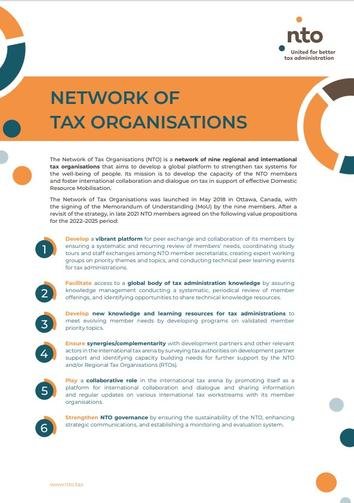
Programme of the 3rd NTO Technical Conference
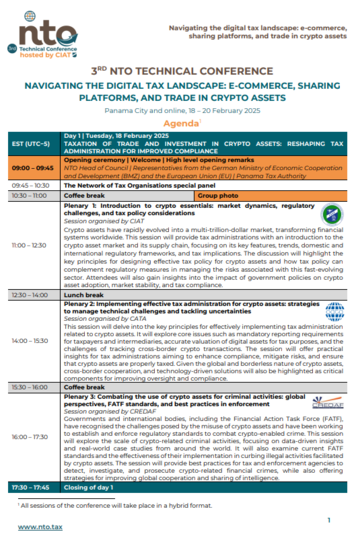
Download English Download Spanish Download French February 2024
Programme of the 3rd NTO Technical Conference Read More »
Download English Download Spanish Download French February 2024
Programme of the 3rd NTO Technical Conference Read More »
Tax network Overview About The Association of Tax Authorities of Islamic Countries (ATAIC) aims to facilitate the development and improvement of tax and zakat policies and administrations in all their aspects, in order to meet the challenges of a rapidly changing world. ATAIC aims to provide a forum for discussion, deliberation and the sharing of experiences, foster mutual co-operation and assistance among the tax authorities in member and associate member countries, and further the important role of tax and zakat administration in the promotion of economic development. Currently, the network counts 28 members, concentrated in the Middle East, Northern Africa and South East Asia. Country membership is based on a country having some form of the Sharia law (Islamic religion). Objectives Improve effectiveness and efficiency of tax administrations Regional and international partnership and cooperation Forum for exchange Activities Research Conferences Seminars and workshops Organisational Structure Permanent Secretariat Members Secretary General Other staff (to be approved by Heads of Delegations Meeting) Responsibilities Administrative affairs of the association Heads of Delegations Meeting (annually) Members Representatives of all full members Responsibilities ATAIC’s supreme body that supervises all activities Appoints the Secretary General of the association and approves the budget of the Permanent Secretary Resources Annual membership subscriptions, the amount of which are determined by the Heads of Delegations Meeting Voluntary contributions from member countries Grants, subsidies, contributions and other funds from development partners/organisations upon the approval of the Heads of Delegations Meeting Related websites Website of the Association of Tax Authorities of Islamic Countries
Association of Tax Authorities of Islamic Countries Read More »
Tax network Overview About The Pacific Islands Tax Administrators’ Association (PITAA) serves as a platform for information exchange. PITAA offers a forum for cooperation and coordination in the area of exchange of information and policy formulation. Further, the network promotes international standards and best practices in the region as well as the modernisation of tax administrations. To reach these goals, PITAA organises capacity-building measures and facilitates the exchange of knowledge, data and experiences. PITAA accounts for 16 member countries. Objectives Improve effectiveness and efficiency of tax administrations Regional and international partnership and cooperation Forum for exchange Technical assistance Activities Conferences Publications Seminars and workshops Organisational Structure Secretariat Responsibilities Carries out activities to support the members in improving their capacity and capabilities Heads of Membership Meeting (annually) Responsibilities Supreme decision-making body of PITAA Adopts the agenda and approves applications for membership and observers Identifies projects consistent with the objectives of PITAA Approves project timetables Established project committees Executive Committee Members Chair of the PITAA Heads Meeting, Vice-Chair, three representatives Resources Support from donors, mainly PFTAC (Pacific Financial Technical Assistance Centre) and World Bank Related websites Website of the Pacific Islands Tax Administrators Association
Pacific Islands Tax Administrators Association Read More »

Tax network Overview About With a special focus on training measures, the Caribbean Organisation of Tax Administrators (COTA) envisages the support and development of efficient tax administrations in its member countries. COTA includes all members and extraordinary members of the Caribbean Community (CARICOM). Objectives Improve effectiveness and efficiency of tax administrations Regional and international partnership and cooperation Technical assistance Activities Research Conferences Publications Seminars and workshops Organisational Structure COTA Secretariat Members Executive Secretary (officer advising the Secretary General of the Caribbean Community on Tax Administration) General Assembly (bi-annually) Members Representatives of all member states Executive Council Responsibilities Organises the provision of targeted support to tax administrations Resources COTA is a subsidiary of the Caribbean Community (CARICOM) and is supported by it Related websites Website of the Caribbean Organisation of Tax Administrators
Caribbean Organisation of Tax Administrators Read More »
This is the Presentation from Norway for the Webinar on Implementing Environmental Taxes Download March 2024 Norway has a long history of using excise taxes to internalise external costs. The presentationl gives a short overview of the excise taxes with an environmental basis used by Norway, with a focus on the CO2-tax and road usage tax on fuel products. The presentation also discuss current issues regarding the CO2-tax, including the relationship to emission trading and handling of biofuels. Battery electric vehicles and hybrid electric vehicles currently dominate new car sales in Norway, and in this context a project to replace the road usage tax on fuels with a national position based (GPS-based) road user charging system are discussed.
Implementing Environmental Taxes: Norway-best practices and lessons learnt Read More »

Tax network Overview About The Intra-European Organisation of Tax Administrators (IOTA) offers its members a platform for cooperation at the European level. Through IOTA, members have the opportunity to exchange information and good practices. Further, IOTA provides professional knowledge and expertise on practical tax administrative issues through technical Events (workshops, case study workshops, special interest workshops, hot topic workshops, forums, webinars, etc), its Annual International Conference, projects (conducted as part of the Forums’ mandates as well as sponsored by members), Technical Enquiries, Technical Assistance, Publications (Tax Tribune Magazine, IOTA Papers, IOTA Books, Reports, Guides, etc.). IOTA has 44 member states. Objectives Improve effectiveness and efficiency of tax administrations Regional and international partnership and cooperation Forum for exchange Technical assistance Activities Research Conferences Publications Seminars and workshops Organisational Structure IOTA Secretariat Responsibilities Technical and administrative functions of the organisation Affairs entrusted by the General Assembly, the Executive Council and the President General Assembly (annually) Members Heads of the tax administrations of the member countries Responsibilities Supreme decision-making body of IOTA Executive Council Members President, eight members Responsibilities Managing and following up on the performance of activities Executing the budget supervising the Secretariat Resources Annual membership contributions that are calculated on the basis of the average GDP of members in the last three years, whereby members are classified in eight groups Fees received from observers Voluntary contributions and donations Fees received from the provision of services Related websites Intra-European Organisation of Tax Administrations (IOTA)
Intra-European Organisation of Tax Administrations Read More »
Tax network Overview About The Study Group on Asia-Pacific Tax Administration and Research (SGATAR) was established in 1970 as an annual forum for tax administrators to enhance cooperation, improve administration and discuss issues related to tax administration. SGATAR’s activities have centred on aiding administrative reform through the sharing of information and insights in regard to specific tax issues. More broadly, it has sought to facilitate the alignment of various tax systems in the Asia-Pacific region in order to foster a tax regime favourable to the smooth development of trade and investment. Mission “To provide a platform to enhance the performance of tax administrations in the Asia-Pacific region by promoting collaboration and communication among member tax administrations.” Objectives Enhance capacity building for members through the sharing of best practices and strengthening training programs Promote bilateral and/or multilateral cooperation in taxpayer compliance and other special projects Undertake research and keep abreast of international and regional developments in tax law and administration Relay our members’ views to international forums Organisational Structure Established SGATAR members take turns hosting the Annual Meeting and providing relevant secretariat support. The ten-member historical hosting order is as follows: Philippines People’s Republic of China Indonesia Japan Malaysia Thailand Republic of Korea Australia Singapore New Zealand Newer (post-1997) members are able to volunteer to host and/or contribute expertise to the Working Level Meetings and Joint Training Programs. The hosts of subsidiary SGATAR meetings report back to the Head Forum on outcomes. Membership There are currently 18 members, including Australia, Cambodia, People’s Republic of China, Chinese Taipei, Hong Kong SAR, Indonesia, Japan, Lao People’s Democratic Republic, Macao SAR, Malaysia, Mongolia, New Zealand, Papua New Guinea, Philippines, Republic of Korea, Singapore, Thailand and Vietnam. Annual SGATAR Meetings serve to strengthen the solidarity of members. There are also a number of observer jurisdictions and organisations that attend the Annual Meeting. Such meetings are known to attract more than 200 delegates. SGATAR Taskforce The SGATAR Taskforce fulfils the role of a secretariat, along with a mandate to seek continuous improvements in the way that the association is administered and run. Taskforce membership follows the hosting cycle – the current members are Thailand (2023 Chair), the Republic of Korea (2024 Chair), and Australia (2025 Chair). Related websites Study Group on Asia-Pacific Tax Administration and Research (sgatar.org)
Study Group on Asia-Pacific Tax Administration and Research Read More »
Tax network Overview About The Centro Interamericano de Administraciones Tributarias (CIAT) is an intra-American network of tax administrators founded in 1967. CIAT is set up to support member countries’ efforts to enhance the development and institutional strengthening of tax administrations as well as their social acceptance. Further, the network encourages international cooperation and the exchange of good practices. The network aims to promote international cooperation and the exchange of experiences and information and render technical assistance services, studies and training, thus contributing to the strengthening of the tax administrations of its member countries. To achieve these objectives, CIAT provides technical assistance programmes, supports studies and research projects, and disseminates their results. Currently, CIAT accounts for 42 member countries, out of which 32 are of the Americas. Additionally, there are five European members, four African members and one Asian member. CIAT endorses the ATI objectives of the Addis Tax Initiative and has joined the Addis Tax Initiative as ATI supporting organisation. Objectives Improve effectiveness and efficiency of tax administrations Regional and international partnership and cooperation Forum for exchange Activities Research Conferences Publications Seminars and workshops Working groups Organisational Structure Executive Secretariat Members Executive Secretary (legal representative of CIAT) Responsibilities Executing CIAT’s technical and administrative affairs strategic leadership General Assembly (annually) Members All full members have voting rights on all issues Responsibilities CIAT’s supreme decision-making body Executive Council Members Nine Council members elected annually by the General Assembly Responsibilities Managing activities Executing the Executive Secretariat budget Outlining CIAT’s institutional strategies Resources Primary funding source is the annual contributions of members countries and associate members. The contribution amount is classified (into 7 categories) in accordance with the respective GDP of the member countries. Member country contributions are adjusted annually based on the Panama inflation rate for the previous calendar year, as reported in the annual IMF Report An annual in-kind contribution is added in Panama Partner organisations provide co-funding for individual events, workshops and trainings Revenues from the provision of technical assistance and virtual training services Related websites Centro Interamericano de Administrationes Tributarias (CIAT)
Centro Interamericano de Administraciones Tributarias Read More »

Tax network Overview About The Cercle de Réflexion et d’Échange des Dirigeants des Administrations Fiscales (CREDAF) aims to enhance the dialogue and exchange between its members as well as with multilateral and international partners on tax matters. Activities include symposiums, seminars, working groups, training measures, the conduction of studies, and the development of guidelines. Currently, CREDAF comprises 30 francophone member countries across the globe. CREDAF endorses the ATI objectives of the Addis Tax Initiative and has joined the Addis Tax Initiative as ATI supporting organisation. Objectives Regional and international partnership and cooperation Forum for exchange Activities Research Publications Seminars and workshops Working groups Organisational Structure CREDAF Secretariat Members Secretary General Advisor Assistant of the Secretary General Responsibilities Administration of the organisation Executive Board Members President, Vice President, and eight administrators General Assembly (annually) Responsibilities examines and adopts the activity program and the budget presented by the executive Board. approves, straightens or corrects the accounts for the previous financial year. delegates to the Board the powers it deems appropriate to entrust to it. appoints the Secretary General and the Deputy Secretary General. appoints the external auditor responsible for verifying the accounts of the Association. chooses the country where the headquarters of the Association and the headquarters of the General Secretariat are fixed. fixes the amount of annual membership fees. elects the Board from among its members.Decides on the topics for the Directors’ seminars Selects a topic for the working group (upon recommendation from the executive board) Resources Membership fees based on GNI per capita Provision of staff by members Partners may bear some costs (depending on the topic) Related websites Cercle de Réflexion et d’Échange des Dirigeants des Administrations Fiscales (C…
Cercle de Réflexion et d’Échange des Dirigeants des Administrations Fiscales Read More »