NTO Tax & Covid-19 Peer-learning – Programme
Download
NTO Tax & Covid-19 Peer-learning – Programme Read More »
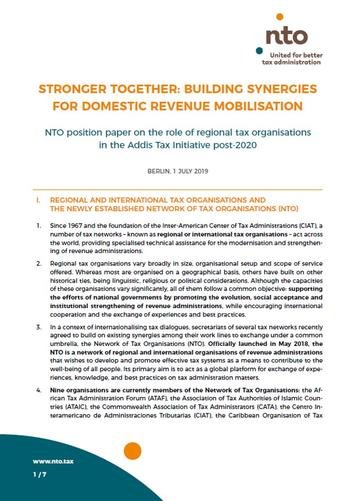
Download English Download Spanish Download French July 2019 In this position paper, the Network of Tax Organisations outlines the following recommendations for the Addis Tax Initiative post 2020: Recognise its unique set-up with partner countries and development partners coming together at one table united by their common goal. Step up efforts in reaching out to non-ATI partner countries, especially in the Asia Pacific region and Latin America. Support the ATI in taking over a more active role in donor coordination at the international level. Launch a new ATI Declaration by 2020. Focus on the objectives of aid effectiveness and donor coordination and better taking into consideration the absorption capacities of partner countries; Recognise the role that regional and tax organisations and the NTO can play in promoting South-South cooperation, notably through peer-to-peer exchanges, and needs-based aid delivery to DRM. Consider supporting the NTO and its member organisations as best-placed and reliable partners to assess and report on the effectiveness of DRM initiatives conducted in their member countries, and ensure DRM efforts are targeted in areas where it has the most impact. Commit to strengthening the inclusiveness of international tax standard setting processes and to supporting the NTO in providing a stronger voice to partner countries within existing international frameworks.
Stronger Together: Building Synergies for Domestic Revenue Mobilisation Read More »
Download The NTO Governance Document serves as guidelines regarding the roles, responsibilities and procedures within the framework of the NTO. It complements the Memorandum of Understanding.
NTO GOVERNANCE STRUCTURE AND RULES OF PROCEDURE Read More »
NTO Strategic Plan 2018-23 Download English Download Spanish Download French The 2nd Network of Tax Organisations (NTO) Technical Conference was held in Cape Town from 5 to 7 of September 2023 in hybrid format. The Conference convened tax officials and experts from all over the world to delve into the domain of digitalisation in tax administrations and reflect on opportunities while addressing contemporary challenges. The digital revolution which has made technological changes in the business of tax administration a necessity, however, presents both challenges and opportunities. Digital transformation and technology have the potential to positively shape the way tax administrations collect, process, and act on information by helping them be more effective, efficient, transparent, and equitable. Transparency which comes with the digitalisation of taxpayer information, among others, could further improve taxpayers’ trust, develop the state-citizen relationship and lead to an efficient DRM. Moreover, with the aid of technology, tax authorities could increase compliance and reduce tax evasion, and decrease administrative/enforcement cost. Alongside these positive attributes, however, the journey towards digitalisation has challenged tax administrations across the world. In the context of developing countries, tax administrations are faced with various technological barriers including the lack of basic infrastructure, e.g., internet access, and lack of largescale access to digital financial services thereby preventing them from taking advantage of the opportunities presented by digitalisation. Further, the tax authorities have historically been outsourcing their bureaucratic functions to private institutions and agencies. The result has been the deployment of multi source applications, infrastructure, and hardware, that are often incompatible with one another and unmatched with the skills of the tax administration staff. This has undermined their value to the institutions and constrained the return on investment. While transitional and developed country tax authorities have a relatively mature digital infrastructure, their challenge in the digitalisation journey lies on the use of data to improve tax compliance as well as investment to make tax compliance processes as simple as possible. Considering that digital transformation is a pressing agenda for tax administrations worldwide and that improvements in the performance of tax administrations is intertwined with how digital information systems are taken advantage of, and in light of the challenges mentioned before, the NTO chose to address the topic of “digital transformation of tax administrations” in its 2nd NTO Technical Conference.
2nd NTO Technical Conference – Report Read More »
This is the Presentation from the South African National Treasury for the NTO Webinar on Environmental Taxes Download PDF
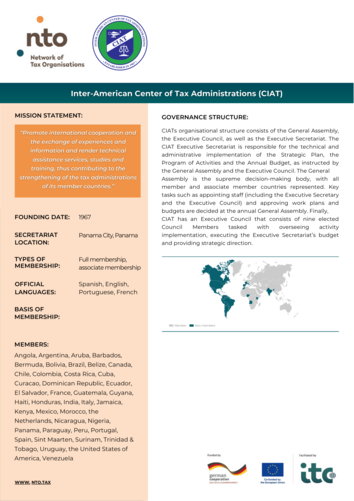
The Inter-American Center of Tax Administrations (CIAT) is a member of the Network of Tax Organisations (NTO). To learn more about CIAT, have a look at the CIAT factsheet. Further information on all ten NTO members can be found in the NTO Practical Guide. The NTO Practical Guide aims to provide an overview of the functions of regional and international tax organisations, the nature of their institutional arrangements, as well as the activities they are performing and to draw some light on the recently created NTO. To access the full guide, please click here. Download PDF
Inter-American Center of Tax Administrations (CIAT) Read More »
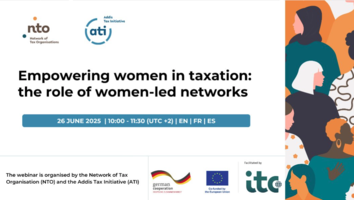
Presentation – Empowering women in taxation: the role of women-led networks Download PDF
Empowering women in taxation: the role of women-led networks Read More »
NTO Strategic Plan 2018-23 Download PDF
NTO Strategic Plan 2018-23 Read More »
3rd NTO Technical Conference – Panama City: Presentations Download PDF
3rd NTO Technical Conference – Panama City: Presentations Read More »